Tuesday, 30 November 2010

Boyo's Own adventure

He may be a Hollywood actor, starring in a glossy TV drama with a constellation of stars, but Matthew Rhys is just an ordinary Welsh lad, worrying about the rugby. Although he loves Los Angeles, it's no Cardiff, he says, and certainly doesn't invite impromptu pints in the pub. "It's so vast, we're dotted all over. So you either drive and don't drink, or you stay the night at whoever's nearest to the pub we're going to," he says. It is a problem.

Rhys is polite, sincere, funny and easy to talk to. He's obviously interested in other people – I realise with horror when I play back my tape that I have spent nearly half the time wittering on about my job, my flat, my degree, my travels. His answers to my questions are lengthy and intelligent and thoughtful, but I get the impression he's just as happy quizzing me than talking about himself.

Rhys has played Kevin Walker in Brothers & Sisters for five years. That's a long spell in a profession where insecurity is a given. "It's like having a weird office job," he says. "I go to the same place every day, I park in the same spot, I turn up in shorts and flip flops and then put on a suit." His character – who happens to be gay, rather than being "a gay character" – is rarely without a shirt and tie.

Does he enjoy the routine? "It's nice to have security, but part of me misses the variety that comes with not knowing what you're going to do next." The cast (Sally Field, Rob Lowe, Calista Flockhart and Rachel Griffiths among them) are great mates – he was recently best man at his co-star Dave Annable's wedding.

Rhys's latest role is less stellar: he is bringing to wider attention, with first a documentary and now a travelogue, the extraordinary heroics of a small group of Welshmen in Patagonia, Argentina. Almost 125 years ago to the day, a party of 29 men left the safety of a small Welsh colony, established 20 years earlier, in search of more fertile land – and with it, survival – in the Andes. Their gruelling 700km journey, on horseback, took them five-and-a-half weeks.

To commemorate the 125th anniversary of the trip, descendants of the original men decided to recreate the entire journey. And Rhys persuaded them to let him come along.

"In my ignorance or arrogance, I underestimated the physical challenge of it," he says. "I didn't realise we would be in the saddle so long, and by the third day, I wasn't sure if I was up to it."

Part of the attraction was to document some real Welsh heroes "who make you feel good about being Welsh", he says. "I was a big cowboy fan when I was growing up. Wales doesn't have those kinds of heroes, so I wanted to get their story out."

He came across it when he stumbled on the diary of John Murray Thomas, one of the group's leaders. “He was a great adventurer. What they did was the equivalent of space travel, unknown and incredibly dangerous. We’re [the Welsh] not really known for our pioneer spirit, but here was someone who very much was.”

Rhys found extreme contentment on the month-long ride. "It was an immediately gratifying, real experience," he says. "You're not pretending to be anyone else."

Patagonia is the subject of his next film, out in March, in which he plays an Argentinean of Welsh descent.

He is drawn to stories like this. A few years ago he made a documentary about another extraordinary character, Griffith Jenkins Griffith, a Welsh-born industrialist who donated parks and public spaces to Los Angeles, but become better known for shooting his wife and spending two years in prison.

As well as promoting charismatic Welshmen, it seems the attraction of telling these stories is having a bit more creative control. "If you break up the elements of film acting, your input and satisfaction can be weak," he says. "You're reciting someone else's words, under someone else's vision, wearing clothes someone else has told you to wear. And the director and editor get to decide how it all turns out.

"I've started directing a bit on the show" – he has three episodes under his belt – "and I find it really gratifying. Everyone asks you how you'd like something shot, and you think, wow – I have an opinion on how this looks, what happens, the tone."

Rhys is about to reprieve, briefly, his role as Benjamin in The Graduate (he starred opposite Kathleen Turner on stage in London), this time for radio in LA. "I miss the theatre enormously. The Graduate feels like a lifetime ago but it was one of my best jobs. Everything clicked. The cast got on, we had a great social life with it, and it was great to make people laugh every night.

"It's weird how your perspective changes. At the start of your career you think, I just want to do cutting edge work that makes people think. Now, I would do a blockbuster in a heartbeat." What changes? "Just the awareness of what we do," he says. "Don't get me wrong, I take it very seriously and work very hard. But at the end of the day, we're entertainers."

Crossing the Plain, published by Gomer Press, is out now.

Black and white photographs: Matthew Rhys

Wednesday, 25 August 2010

Brief Encounters: circulation

Rui, our regular swimming coach, is a dark-haired, sun-kissed, Portuguese janota who looks too warm-blooded and Mediterranean to enjoy the chilly, 15 degree waters of Parliament Hill lido on a Wednesday morning.

So I usually get a sympathetic response when, as one of the few people swimming without a wetsuit, I climb out after 40 minutes to defrost in the showers.

But today, Rui wasn't there. Instead we had a tough-looking drill master with a crew cut, barking instructions like an East End Sergeant Major.

"You're cold?!" he said, as I got out early. It was as if it was the oddest, most unlikely thing I could have said.

"I think it's time I got a wetsuit," I replied. "Never use one," he said. "And I swim all year round. Just swim harder."

He smiled, and I realised that underneath the crew cut, he was a softy. And perhaps, secretly, a little bit impressed that among our group of wetsuit-clad, big-shouldered men, I was the only one braving the cold.

Sunday, 6 June 2010

Midsummer Madness

The last time I met a group of strangers in a layby it was 1989, the second Summer of Love. Under-age and under dressed, we were trying to find a field with a rave in it.

Over 20 years on, I'm doing something a little more age-appropriate but just as fun: meeting outdoor swimmers, pulling on a swimsuit and jumping in a river.

After making friends in a heartbeat – standing semi-naked by the side of a B-road does accelerate the bonding process – we pick our way across a field. We're quite a sight: barefoot, red hats, wet suits and goggles.

Chat is excited but a little nervous. How long will the swim take? How cold will the water be? Will the current help us? What happens if we want to get out early? We pass a group of picnickers, flushed pink from the sun and the empty bottles of wine littering their rug. They wave and shout words of encouragement.

Soon we're at the riverbank. Here in Oxfordshire, we are around 40 miles from the source of London's great river. The water is brown-green, clean and sleepily slow-moving, the bank lined with lush shrubbery.


I hop down and into the shallows, surprised to feel sand between my toes. The water is colder than I expected but as soon as I dive under and stretch out, my shivers pass and it cools me down. I am at the front (it won't last), cleaving through the water at a gentle pace. No-one is racing: strokes are languid as we drink in the surroundings. It's exceptionally peaceful, just the lapping of the water, murmuring chat and the occasional whoop behind us as someone enters the water.

Reeds and leaves become entangled in my fingers. Ducklings wobble past. And every five minutes a large boat looms into view. It makes me feel very small bobbing at water level as they cruise past.

After a kilometre or so, I'm starting to chill. Most people are in sturdy wetsuits but my new-found friend and I are in skimpy swimsuits (it was only a last minute change of heart that made me leave my bikini at home). So we get out at a stretch of sand and walk back to the parked cars. Our goose bumps are soon warmed by the afternoon sun.


We catch a lift to the end of the swim, at the village of Shillingford a mile away, and await the swimmers (pictured, above – that's me by the barge wrapped in a woolly grey cardigan).

Soon, red hats appear around a bend in the river. They reach the bank and clamber out into awaiting towels, beaming with the joy of exertion, relief and pride. I haven't enjoyed a Saturday afternoon this much in years.

Thursday, 27 May 2010

Storm in a treehouse


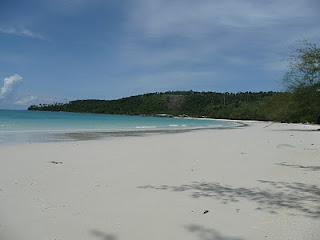
Koh Rong is a tiny island off Cambodia's south coast – 15km of pristine jungle and pale sand so soft it feels like icing sugar between your toes.

A few hundred people live here, their corrugated huts lining the beach on the island's eastern edge. Their children attend a local school. They fish. And they provide food and drink for the small groups of scuba divers who explore Koh Rong's emerald waters.


Until recently, few tourists visited this beach. But in the past couple of months, a handful of wood and thatch bungalows have appeared among the trees. And if you keep walking, round a tiny headland, you reach few more, including a magnificent treehouse, two storeys high with vertiginous steps, waves lapping at its feet and heart-stopping views out to sea.

This is where we spent the night.


The treehouse was built by Nuch Ros, a beautiful, bubbly girl from Sihanoukville across the water, and her Turkish husband, Bora Ozturk (she fed us hot sour soup to revive me after the bumpy crossing). It has a large bed with a mosquito net, open sides to catch the breeze, even a shower. We threw down our packs and dozed to escape the searing midday sun.

A word on that: it is a hardier traveller than I, I have discovered, who braves Cambodia on the cusp of the rainy season. Most days it reaches 40 degrees, and it is so humid that I swear I sweat even in the shower. I am always, always hot. A fan is a must, air-conditioning preferable, otherwise sleep (in the loosest sense) involves lying in one position long enough for the sheet to soak, before rolling onto a drier patch and repeating.

The rains are on their way, though. Most evenings, thunder rumbles like timpani and lightening forks through the clouds, sometimes followed by a short downpour that cools the air momentarily.

But that night in the treehouse, there is no relief. We are sweating and fanless (the generator is turned off at 9pm). We watch three storms over the mainland, praying for them to reach us, but instead, the air is as thick as noodle soup and the surf beneath us turns listlessly. Sleep is impossible.

Suddenly, a light breeze blows across me. It is almost imperceptible, but I sit up nonetheless to feel its effect on my body. It slowly picks up, and soon my wet skin is drying, the mosquito net is billowing gently and the mercury is falling. I am pathetically grateful.

It doesn't take long to stiffen and minutes later, an empty water bottle blows off the window ledge and lands with a clatter on the floor. Suddenly, lightening fills the entire room, thunder rumbles angrily and the rain comes down.

We're now wide awake. The mosquito net has come loose completely, but I tuck it back under the mattress. It's a pointless exercise as it is whipping around us like a main sail in a gale. A towel and a bikini, tied securely to the balcony, are whisked away into the night. Rain is slicing through the open windows, and the sea is roaring beneath us. Thunder claps deafeningly directly above our heads.

I point out that the treehouse, barely two months old, hasn't yet weathered a rainy season. And suddenly we are laughing uncontrollably, tears streaming down our faces, hysterical with relief, excitement and fear that our treehouse is going to collapse into a heap of sticks.

The storm continues at this intensity for over half an hour. We've stopped laughing, we're cold and wet and we just want it to end. Finally, after a few false alarms, the wind subsides, the mosquito net hangs loose again and I fall into a deep, cool, exhausted sleep.

Tuesday, 20 April 2010

Living off the land


The tribal people of the world don’t have much of a voice. But journalist Joanna Eede has been collecting their extraordinary stories. She has spoken to Bushmen in Botswana, Amazonian Yanomami and Canadian Innu, among others, about their lives, homes and beliefs.


“This is our land. Do only people live here? No, there are also monkeys, even bears. The land is for everyone, men, animals and plants. The land is full of the spirits of our forefathers, it is a reciprocal relationship. The land is for our men of today and for our children.” So say the Asháninka tribe in Peru, echoing the beliefs of tribes the world over.


These people inhabit some of the most remote corners of the earth: tundra, sea-ice, mountains, deserts and prairies. They have done for thousands of years. “The affinity with their homelands is reflected in the names tribal peoples call themselves,” says Eede. “They are the savannah people, the people of the headwaters, the people from the wild pig place.”


“We did not think of the great open plains, the beautiful rolling hills, the winding streams with tangled growth, as ‘wild’,” says Luther Standing Bear, an Oglala Lakota Sioux. “Only to the white man was nature a ‘wilderness’ and only to him was it ‘infested’ with ‘wild’ animals and ‘savage’ people. To us it was tame.”


Each tribal society is unique. But most share the belief that man and nature should live together – and that a long-term attitude to the caretaking of the planet is vital. “The Iroquois of North America always consider seven generations ahead in their decision making,” says Eede.


We can learn from these wise people, who tread lightly and lovingly on the planet. "Only we, the indigenous people, know how to protect the forest," says Davi Kopenawa, from the ancient Yanomami tribe in the Brazilian rainforest. "Give us back our lands before the forest dies. It is dangerous to abuse nature. The sky is full of smoke because the napë, the non-Indians, are logging and burning our rainforest. The rains come late, the sun behaves in a strange way. The lungs of the sky are polluted. The world is ill."


This week, indigenous people in Brazil are threatening violence after a successful tender for the rights to build a giant hydro-electric plant on their ancient land. "Indians will be forced to kill the white men again so they leave our lands alone," says Kayapó leader, Raoni Metuktire.


We can also learn from their philosophy on life, too. "The desire for possessions is destructive," says Davi Kopenawa. "Nothing that can be bought, or sold, has any real meaning. Possessions are looked upon as symbols of advanced humanity, yet they disappear with the wind. All they do is cloud the mind and pollute the soul."


What can we do? Tell their stories, the tribal people say. "You have seen with your eyes what is happening here," says a Bushman in Botswana. "Go and tell people what you have seen. What would make us happy is if we have the rights to stay on our land."


Last Sunday, a glamorous gathering of actors staged a one-off benefit in London, performing readings from Eede's book, We Are One, which was written for the charity Survival International to mark its 40th anniversary. Julie Christie and Gillian Anderson shared a stage with Derek Jacobi and Mackenzie Crook. Sadly, Colin Firth didn't make it...


Should we care that tribal people are being forced away from their land and livelihoods? "Yes, if we believe that taking other people's lands – and so destroying them – should not be tolerated," says Survival International director, Stephen Corry. "They teach us that price and value are not the same things, and that community can be more intelligent and humane than government."


Or, as Cecilia Mitchell, a Mohawk in the USA puts it: "Different people, different ideas and different beliefs make life so much more interesting.”


Photographs, from top: Mike Goldwater, Grenville Charles, Bruno Morandi

Brief Encounters: ticket

Settled by the train window, the sun streaming in, the elderly man reminded me of a character in a Graham Greene novel: smart hat, straight back, distinguished nose. He was heading, via London, for the coast. Where, I asked? "Brighton. Or Weston-super-Mare. I don't know yet," he said, with admirable free-spiritedness.
"I remember the golden age of steam," he said to no-one in particular. He tried to get a small boy interested in the semantics of the albatross insignia on his uniform, but all he wanted to do was spot Wembley Stadium.
I tried to buy a ticket but the inspector's machine was broken. The man flashed his free pass – "43 years on the railways got me this," he said. He offered to escort me to the ticket gate to back up my broken machine story. But when we pulled into the station, there was no barrier.
He looked concerned, and for a moment I thought he was going to march me to a ticket desk. But then he cracked a smile: "Good job his machine was broken, eh? And to think, I had to work for my free trip." And he shuffled off across the concourse.

Sunday, 21 March 2010

Eruption in Iceland

Icelanders rarely forget they live on a groaning, fiery land-mass astride two of the earth's giant plates, the Mid-Atlantic Ridge (pictured above, the plain caused by the plates pulling apart). But in case they do, a volcano erupts to remind them.

Last night's eruption happened not from a snow-capped crater but from a crack in the earth about 1.5km long, near the Eyjafallajoekull glacier. If it erupts again – and a relatively small eruption like this often precedes a bigger one – the glacier could melt, causing devastating floods. Worse, nearby is Katla, one of the country's largest, most dangerous volcanoes. When there is activity nearby, it often starts to move.

Even in a country used to volcanic activity, it's exciting. When they heard the news, young men left their Saturday night beers to jump into 4x4s and head off for a closer look. All the roads were blocked by police cordons.

How do Icelanders feel about their volcanoes? Greipur Gíslason, one of the organisers of Iceland's second design festival, HönnunarMars – the reason I am here – says volcanic eruptions, unless they are life-threatening, are reassuring. "It's really good," he said this morning, wearing the smile of a secretly proud father whose naughty child has just come top of the class. "It reminds us our little island is working properly."

"The earth has reminded us that its creation is still going on, and that we are not its creators," Iceland's president, Ólafur Ragnar Grímsson, told us today, as we sipped white wine at his home outside Reykjavik. "These ever-present, but unexpected events have a strong influence on the mindset of the country."

"We're excited," a young woman told me. "Katla has been sleeping for too long. Her last eruption was nearly 50 years ago so she is behind schedule." (Volcanoes, by the way, are gender neutral, but the most powerful have female names).

I experienced some of Iceland's awesome energy yesterday on a trip to see Geysir, the hot bubbling spring that erupts every 15 minutes or so (below).


It was awe-inspiring. But I fell in love with the tiny bubbling spring nearby...

I swam in an outdoor pool heated by geothermal energy. And I've showered every morning in piping hot water from the ground. On my flight from London, I sat beside a man who sits on the board of an Icelandic renewable energy company. The country produces more energy than it needs, he told me, but it doesn't know what to do with it. I hope they find a solution: if they do, Iceland will become very rich again.