Friday, 18 May 2012

Less pomp, more circumstance


When you've done something so often it becomes routine, it takes someone pretty special to lift that experience out of the ordinary. Adrian Brown is that man. 

Brown is a conductor who recently started working with my orchestra. I met him for the first time a few weeks ago. He is twinkly-eyed, charming, quick-witted and sounds a lot like Michael Caine – Carry On humour his speciality. But more importantly, he has a deep, spiritual passion for music, and knows instinctively how to convey this to an orchestra full of people like me who have been playing long enough to have heard it all before. 

A conductor will tell you how he – and sadly, he is usually a he – wants something played: shorter, faster, quieter. A good conductor will try to explain why. Brown did both, using language not usually associated with music, while also exploring the more interesting idea of why the composer might have written what he – and sadly, he is usually a he – did. 

An example. A passage in Edward Elgar's magnificent First Symphony sees the strings surging forward in a crescendo and then stopping, abruptly, to play almost inaudibly quietly. Brown told us he believed this was a musical manifestation of Elgar's passion pouring out of him, before he remembers where he is – prudish, Edwardian England – and pulls back, keeping his emotion in check. 

"This is autobiographical stuff!" he told us, more than once. "People think Elgar is all Pomp and Circumstance, but he was actually incredibly fragile." In an interview before the concert, he said: "I am deeply, emotionally attached to Elgar: his foibles, his moods, his difficulties, and his inferiority complex."

He also encouraged us to try to forget the last century of history and imagine we were hearing this music for the first time – not easy. "That key change would have been incredibly radical back then," he said. Later, sitting down to play Beethoven's fifth piano concerto, he stopped us after the first note, as he thought we weren't giving it our all. "This was written for an Emperor!" he said. And thus, without telling us how to play, he conveyed so much more. 

For me, I responded more than I ever have to a conductor, caring deeply about how I played and coming away with a more profound understanding of what I was playing. "Go to the tenderest place in your heart," he told us when we were rehearsing the symphony's exquisite slow movement. We did, and our performance on Monday was all the better for it. 

Tuesday, 13 March 2012

"I didn't think I'd ever recover"


In February 1964, Angela Patrick was a happy, carefree 19 year-old living outside London, working in the city, and having fun with her girlfriends. One Saturday night in Essex, she did what most teenagers that age do – went to a party, got a bit merry, and slept with her new boyfriend.

The consequences of that night are still being felt by Angela and her loved-ones nearly 50 years later. She found herself pregnant, and was forced to do something almost unimaginable – give up her baby son for adoption.

We met a few weeks ago over coffee in the National Gallery and she told me her story, published in yesterday's Guardian. Nearly 50 years on, re-telling it still makes her cry. She was beautiful – less polished than above, pictured left with her daughter – intelligent and warm.

What impressed me most is how she survived her ordeal and went on to live a happy life. And how one tiny event can affect you for life. For once, the platitude "what doesn't kill us..." seems apt.

Photograph: Sarah Lee

Sunday, 11 March 2012

Drawing inspiration

Quentin Blake was ten minutes into a chirpy monologue about who inspires him as an illustrator when something occurred to me: with his small, bird-like features, wispy hair and lively eyebrows, he looked not a little like the people he draws (self-portrait, above; portrait, below by Eamonn McCabe).

I cast my eyes across the rest of the panel taking part in the talk at the British Library –illustrators and cartoonists, Posy Simmonds, Martin Rowson and Jamie Hewlett. Simmonds had the soft, open features and grace of her Tamara Drewe and Gemma Bovary characters; Hewlett, the cheeky, boyish grin of the Gorillaz crew, below (and see him speak briefly here).

Do people who spend their lives creating other people turn to the most obvious person for inspiration – themselves – even if it's subconscious?

My theory, of course, ended with Rowson, a brilliant "visual journalist" whose intricate, political cartoons resemble modern-day Hogarth but look nothing like him. Hey ho.

I adored Blake as a child, never sure if it was his drawings, or Roald Dahl's words, that I loved best. So it was fascinating to discover who inspired him: turns out, he was not alone in his idolatry of Ronald Searle, who died last December (below). "The Godfather," said Blake. "He had the best line," said Rowson (it's a drawing thing). "The greatest illustrator of all time," said Hewlett. "He has completely inspired me all my life."

Hewlett, Blake, Simmonds and Rowson were intelligent, funny and generous, and gave the impression that being an illustrator is an extremely rewarding way to spend your life. It worked for Searle, too: he lived in France, with the woman he loved, and drank champagne every day. As Hewlett said: "What's not to admire?"

Wednesday, 22 February 2012

Encounters: concert

It sounded like a skit from a Woody Allen film:

First man: Are you ready for the next instalment of the tragedy on Sunday?
Second man: Götterdämmerung?
First man: No, Tottenham.

Half the fun in going to a big classical concert – and with André Previn and Anne-Sophie Mutter playing (at the Barbican on Monday) they don't come much bigger – is people watching. It's a great tradition: they did it in all the grand opera houses in Europe.

The people in our row didn't disappoint. The conversation above was between a well-heeled man a few seats down, and a well-heeled friend he met in the aisle. One, fittingly, had a touch of Alan Sugar about him, only with a German accent. The other seemed to know everyone.

But it was their women-folk who were the most jaw-dropping. Hair was expensive, dyed just the right tawny shade, tonged and set with so much hairspray it shimmered. Clothes were showy and tight; jewellery, ostentatious. Faces were taut with Botox, but captivating. And best of all were the accents: exotic Anglo-Euro-German, the voice of a 60s Bond girl.

I don't doubt they were enjoying the music. But as they settled into their seats for the second half, dinner plans were already being urgently discussed. I thought of the sandwich I'd wolfed down before the concert, and vowed, one day, to be this glamorous.

Monday, 12 December 2011

Encounters: loss

The cheese straws I manufactured yesterday morning in catering quantities – for a Christmas soiree – were a little saltier than they should have been. I was listening to journalist Eve Pollard on Radio 4's Desert Island Discs, and moved to tears more than once.

Her parents fled Vienna in the 1930s, but her grandparents died in a concentration camp. Her mother could never speak about them. When the war was over, she had the chance to visit Vienna, but couldn't do it. Jews' houses were routinely looted when they were deported, and she told her daughter she couldn't bear to see another woman wearing her jewellery. It was a small personal detail – a story I'd never heard before – that revealed so much about the lives of ordinary people at the time.

Pollard dedicated one of her songs, the beautiful aria "O mio babbino caro" ("Oh my beloved Father") by Puccini, to her mother, who would listen to it quietly, lost in memories of her Dad.

Like I said, salty cheese straws.

Wednesday, 16 November 2011

Swingers


Envy, I suspect, lies behind my irritation at those 60s icons – David Bailey, Michael Caine, Terence Stamp, Twiggy, any Beatle or Stone you care to name – who are forever saying how exciting it was, how young they were, how they didn't have a clue what they were doing, they just made it up as they went along – how, at any moment, it could disappear in a puff of marijuana smoke. It all sounds so much fun.

Photographer Terry O'Neill, who I interviewed for last Saturday's magazine, was bang slap in the right place at the right time. An eastender like Caine and Bailey, he stumbled into photography by accident. He was picked up in the early 60s by the Daily Sketch, which was after a young snapper to dispatch to the darker corners of London in search of those making the capital swing. The next oldest photographer on Fleet Street was 31 – a dinosaur.

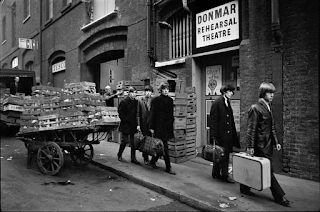
He photographed the Beatles, the Stones (below), the lot – his informal, on the hoof style suiting these equally establishment-upsetting upstarts. "We were all just kids – none of us knew we were going to be famous." Yeah, yeah, Terry, save it.


Today, O'Neill is a short, sweet, twinkly-eyed man who still can't believe his luck, talks merrily about the past, and says there's no-one interesting left to photograph. I beg to differ. But I did enjoy visiting him in his tiny basement studio in Mayfair, filled with boxes, files, drawers and cigarette smoke. I inhaled it along with his stories, pretending I was right back there with him.

Friday, 14 October 2011

Grumpy old man


I've never been a particular fan of Terence Conran. His well-fed, cigar-smoking (five a day, apparently), bon viveur persona – not to mention his ubiquity – hasn't ever sat too comfortably with me.

But I might have to revise my opinion. Meeting him a few days ago at a dinner for his 80th birthday, I got a fascinating glimpse into his personal world, and a new-found appreciation for what he's done for British lifestyle.

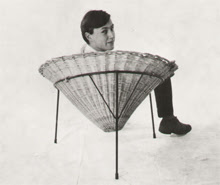
He set up a furniture, ceramics and textile workshop in the East End of London in the late 40s, and worked on the Festival of Britain exhibition in 1951. But his first big public venture was The Soup Kitchen in 1953, a little restaurant just off The Strand. Inspired by trips to France, he served unimaginably exotic wares to a British public still on rations: espresso, French bread and cheese, and soup. Served in mugs! Inside were cane chairs and a quarry-tiled floor.

Conran founded Habitat in 1964 and revolutionised our homes. It sold colourful, exotic furniture and homewares – duvets, woks and Japanese paper lanterns – to that hip young generation, a world away from their parents' heavy, pre-war furniture hand-me-downs. The rest – design shops, divorces, a restaurant empire and designer offspring – is history.

At dinner, he was surrounded by women who had clearly been extremely beautiful in the 60s and still had that decade's tousled, blonde hair and smoky eyes; and dapper, old-school gents, in whom you could still detect a touch of the East End barrow boy.

I sat next to one, Roger Mavity, chief executive of Conran's holding company – unconventional, twinkly-eyed and with a cracking humour. He refused to take the quiz that had been laid on for us seriously, unlike the rest of the room – "It's a bit of a conversation killer, isn't it?" – and regaled me with stories. I was utterly charmed.

Conran, like many of his generation, hates waste of any kind. He works hard, is famously tight-fisted, and loathes mobile phones and bullshitters (notably Tony Blair and George Bush). In a speech at the end of the night, he might have said a few humble thank yous and raised his glass. Instead, he lambasted the Government, said that now he was 80 he better work harder as there was no time to waste, and made a slightly off-colour joke about cutting staff numbers, before someone relieved him of the microphone. And I admired him all the more for it.